Womb-Mates: God’s Plan for Interdependence
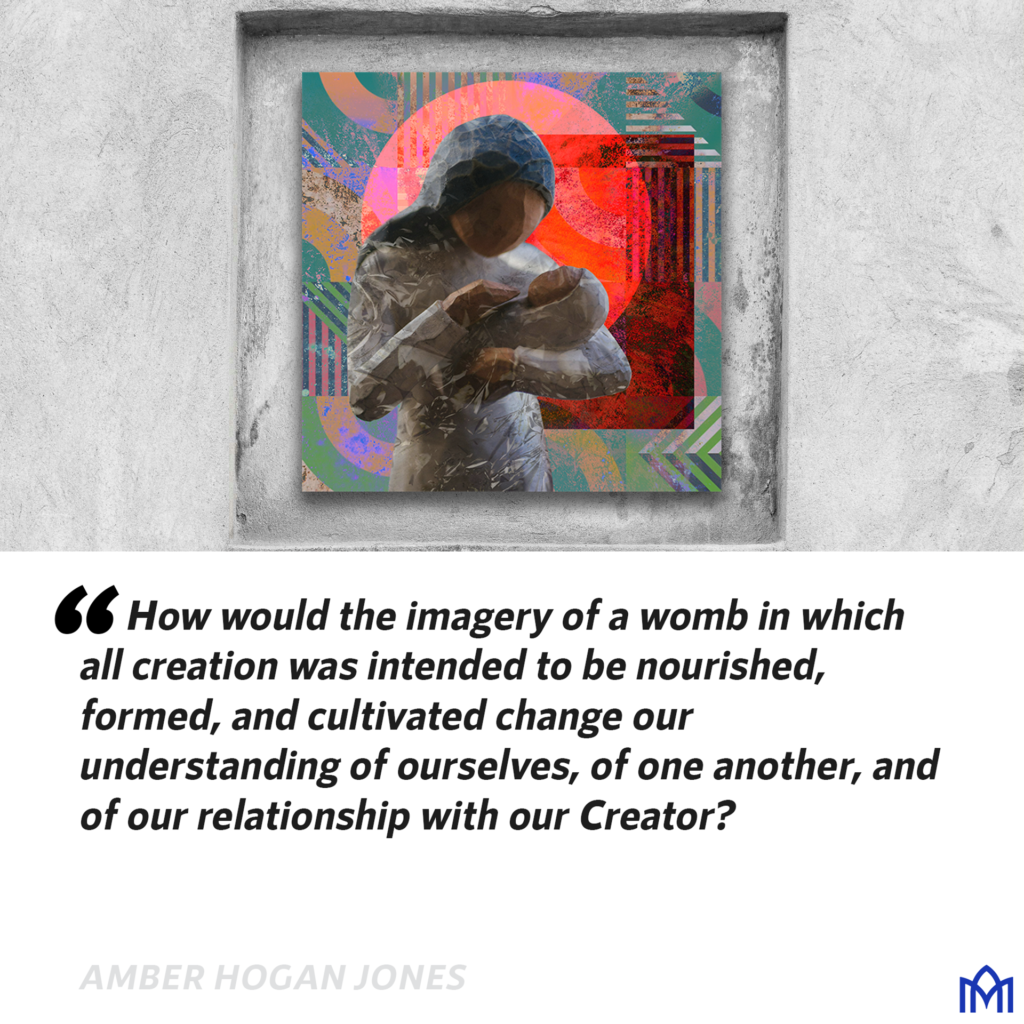
"How would the imagery of a womb in which all creation was intended to be nourished, formed, and cultivated change our understanding of ourselves, of one another, and of our relationship with our Creator?"
We Abandoned Our Mother God (Series, Pt. 2)
“When God began to create heaven and earth, and the earth then was welter and waste and darkness over the deep and God’s breath hovering over the waters…”1Robert Alter The Five Books of Moses: A Translation with Commentary, W.W. Norton & Co., 2019. (Genesis 1:1-2, The Five Books of Moses: A Commentary, by Robert Alter)
“In the beginning there was a womb.”
What would modern Christianity look like if we began our origin story with those words? How would the imagery of a womb in which all creation was intended to be nourished, formed, and cultivated change our understanding of ourselves, of one another, and of our relationship with our Creator?
This line of wondering doesn’t usually go over very well in certain Christian circles. It sounds too feminist, New Age, and even heretical to ears attuned to feminine theological imagery being the ultrasound of poisonous liberalism. However, the first words of the Hebrew canon which set the stage for all creation, supply us this very womb imagery. Biblical scholar and translator, Professor Robert Alter, underscores the point: “The verb attached to God’s breath-wind-spirit (ruah) elsewhere describes an eagle fluttering over its young, and so might have a connotation of parturition or nurture as well as back-and-forth movement.”2Alter, 11. Parturition is the process of childbirth including dilation and expulsion from the womb. Ample biblical imagery exists which depicts God as a brooding, nurturing, fiercely protective mother.3See Deut. 32:18; Isa. 42:14, 46:3-4, 49:15, 66:10-13; John 1:12, 16:21, 4:7; Hosea 13:8; Ps. 17:8, 36:7, 57:1, among many others. Yet, the earth itself is also depicted as a mother–specifically, a mother who is in the process of childbirth.
“We know that the whole creation has been groaning together as it suffers together the pains of labor, and not only the creation, but we ourselves, who have the first fruits of the Spirit, groan inwardly while we wait for adoption, the redemption of our bodies.”4See also Matt. 24:8 & Mark 13:8, in which Jesus describes the cosmic childbirth that is happening all around us.(Romans 8:22-23, NRSV)
The earth as a womb is essential imagery for understanding what unfolds in the poetry of the first chapters of Genesis. The opening scene in Chapter One supplies us with the imagery of emptiness and futility, as the Hebrew tohu wabohu, or “welter and waste” according to Alter’s translation, suggests.5Alter, 11. Interestingly, water is present and being hovered over by God’s ruah, an obvious precursor or parallel to the amniotic fluid in which all human life will henceforth develop. God speaks earth’s mission, which includes the words grow, yield, bear fruit and put forth in perpetuity (vs. 11-13). The earth is to give birth again and again, creating a place for life to be instigated, developed, and generated forever.
A gestation place for all creation. A womb.
How would the imagery of a womb in which all creation was intended to be nourished, formed, and cultivated change our understanding of ourselves, of one another, and of our relationship with our Creator? Share on X
Inside this earth-womb, God created the “two great lights, the great light for dominion of day and the small light for dominion of night, and the stars” (vs. 16-17), all living creatures, and finally human beings. God created humankind in God’s likeness and declared their mission to “hold sway over” the other living creatures of the earth. Here, Alter notes that although the “great lights” were given dominion over day and night, human beings were told to hold sway, which is the Hebrew word radah. Radah is not the normal Hebrew verb for “rule;” rather, it usually suggests “an absolute or even fierce exercise of mastery.”6Alter, 12.
We see human beings made in the likeness of God, placed together inside a womb-like context perfect for life to thrive, and given the mission of mastering the art and craft of generating life upon life upon life, forever. Womb-mates destined to take care of the womb in which they were lovingly and carefully placed.
“And God saw all that He had done, and, look, it was very good.”7Alter, 13. (Genesis 1:31)
When I hear certain commentators from the chronically online “manosphere” talk about women as if they are the enemy, I’m aggrieved by how far they’ve fallen from God’s original design.8A poisonous example among many is the rise of Nick Fuentes, an American political commentator and far-right white nationalist, activist, and live streamer who has become a viral sensation for his hateful rhetoric against women. As of the date of this writing, he has more than a million followers on the social media platform X and tens of millions of views of his online video content. For obvious reasons, I won’t platform his content in this piece. And when I listen to Christians preach and teach about God’s plan for a gender-based hierarchy, specifically that women were made for subordination, I’m devastated for what this rigid and thin interpretation of Scripture is doing to not only the Church, but to the world. Young women are leaving the church for good and in numbers we’ve never seen before.9See https://www.americansurveycenter.org/newsletter/young-women-are-leaving-church-in-unprecedented-numbers for more. By contrast, young men are returning to church as they look for something of a return to tradition.10Again, see https://www.nytimes.com/2024/09/23/us/young-men-religion-gen-z for more. A gender gap in churches is developing, even as one widens in the world at-large. And it’s no wonder. When we compare the myopic, high-control worldview of religiously based gender hierarchy to that of the perspective found in the first two chapters of Genesis, we see a chasm as wide as the East is from the West.
We see human beings made in the likeness of God, placed together inside a womb-like context perfect for life to thrive, and given the mission of mastering the art and craft of generating life upon life upon life, forever. Share on X
Instead of leveraging our very good story of vulnerable interdependence, far too much Christian teaching seems bent on fueling the fire of enmity between women and men, reversing the value system set up for good living found in Genesis and exemplified in the life and teachings of Christ.11An example among many of this is Pastor Joel Webbon, who has joined the likes of Doug Wilson and others to call for a repeal of laws protecting women’s right to vote. See https://politicalresearch.org/strategy/pra-news/christian-nationalist-pastor-joel-webbon-says-women-should-not-be-allowed-vote for more.
In the beginning that good value system was reversed as well.
When the original human beings followed their own appetites instead of trusting in the wisdom and guidance of God, the value system by which they’d been living was abruptly disrupted. In the third chapter of Genesis, we find the woman facing a bleak future in which she will suffer in childbirth and long for her man, who will now rule over her. Likewise, the man was now faced with laboring for survival in a new land of “thorn and thistle,” recalling tohu wabohu, that emptiness and futility that existed before God breathed life into the womb. Humankind would endure this new reality for the rest of their lives: “till you return to the soil, for from there you were taken, for dust you are and to dust you shall return.”12Alter, 16.
“Naked I came from my mother’s womb, and naked shall I return there.” (Job 1:21, NRSV)
They were created and placed in a womb-like context where the value system was based on vulnerability. In every way, “they were naked…and they were not ashamed” (Gen. 2:25). This value system was also based on generativity, creativity, and equal collaboration in which they were meant to master the art and craft of this godlike ability to create and sustain good life. Cooperation, caregiving, mutual pleasure, and innocent interdependence were the hallmarks of Edenic existence. The Curse found in Genesis three was a declaration of the tragedy that had now befallen them as their soft, innocent eyes were replaced with hard, suspicious ones. These womb-mates were now doomed to suffer in body, mind, and heart as the intimacy they’d enjoyed so freely disintegrated under the weight of survival.
When we read this ancient story, it’s appropriate to grieve what’s been lost.
Instead of leveraging our very good story of vulnerable interdependence, far too much Christian teaching fuels the fire of enmity between women and men, reversing the value system set up for good living found in Genesis. Share on X
What’s unthinkable, however, is that we would read this tale and have any desire to perpetuate this broken value system in the world. The Good News of the gospel is that Christ came to us as the “New Adam,” restoring to us the original value system of life and love, and providing us the ability to learn to live within this system again.13See 1 Cor. 15:45-49 and Romans 5:12-21. Jesus was clear: We must be willing to return to the womb and go through spiritual parturition if we want to live in the Kingdom of God who has deemed the womb as the perfect context for us to create the good life together.14John 3:3-7 speaks of this in greater depth.
The earth-womb is a great equalizer because we’re all dependent upon its hospitality and continued fruitfulness to the same degree. Gender based hierarchy and furious boundary maintenance around gendered “functions” and roles is inappropriate and distracting when the focus is on the business of the womb. This business, as theologian Dr. Thomas Reynolds beautifully describes, is simply “The Spirit at work creating relations of reciprocity between God’s children.”15Thomas Reynolds (2008), Vulnerable Communion: A Theology of Disability and Hospitality, Brazos Press. If the purpose of being created as gendered beings wasn’t to establish a cosmically ordained hierarchy, but to practice interdependent reciprocity which mirrors the inner economy of our Triune God, the entire tone and texture of our relationship together as women and men dramatically changes.
Imagine churches filled with people who are collectively committed to an Edenic value system instead of adopting a corrupt and cursed value system. Too Utopian or Pollyannaish? Not feasible or practical? Those are the same doubts the serpent whispered in Eve’s ear, the same ones Satan presented to Jesus in the desert, and the very same kind hurled at Jesus in mockery as he hung from the cross. This doubt in the ability of God’s people to live by the value system of God in a world that relentlessly resists this value system is not new, and it is not grounded in logic. This doubt has it’s roots in fear–if we return to the womb and practice vulnerable, interdependent reciprocity in our homes and churches, we will not be able to survive in a hostile world of welter and waste.
While this fear is completely understandable, it does not excuse us from risking it all in at least imagining what church might look like if we took Jesus’ re-wombing words seriously. Fear does not give us permission to embrace the warped value system of The Curse and to perpetuate enmity between human beings. The truth is that Christ’s work in reversing The Curse continues, whether our pet doctrines or personal biblical interpretations align with it or not. Christ is at work reconciling all to Himself despite our resistance. The questions are not about Christ’s work, but about our part in it.
Though it will most certainly cost us our comfortability, will we be courageous enough to join Him? Are we willing to name the damage our doctrines of enmity have done to the church and the world? Can we risk imagination and experimentation for the sake of reconciliation and restoration? Will we listen deeply and be willing to change? And perhaps most importantly, is it possible for us to allow our womb-mates to be agents of healing in our own lives?
“What does God do all day long? God gives birth. From all eternity God lies on a maternity bed giving birth.” (Meister Eckhart)
The moment in which we can look at our womb-mates as our brothers and sisters, as our partners in the grand adventure of being re-wombed, we access a collective power that has long lain dormant. The energy and time spent on fighting about and attempting to maintain rigid gender hierarchy will be instantly re-purposed into time and energy spent on rebirth and renewal. We can create together a truly countercultural movement that is inviting and healing to both women and men, that leaves our communities better and not worse, and that signals to the world the kind of beauty and wholeness that happens when human beings are connected to their Source and to one another.
While the world wrestles in the welter and waste of domination and control, we can open the doors to our sanctuaries with the promise of warmth, healing, and nourishment. Together, as womb-mates, we can offer something different – not viral videos of hatred, not podcasts and sermons of shame and control – but a faithful place to be re-wombed into our original design, as people of vulnerable interdependence who build a community of love so sturdy the words of the Psalmist echo from our walls with a truth that even the most hard-hearted and suspicious can’t resist: “This is the Lord’s doing; it is marvelous in our eyes.”16Psalm 118:23, NRSV.
///
*Editorial Note: I have immense respect for Rev. Dr. Amber Hogan Jones. Her deep writing, impeccable theological research, and warm formational invitation into the nurturing, mothering heart of God is compelling. I urge you to listen to her. Amber’s ongoing series, “We Abandoned Our Mothering God” can be read here and here.~CK
We can create together a truly countercultural movement that is inviting and healing to both women and men, signaling to the world what happens when human beings are connected to their Source and to one another. Share on X