Our Bubble Must Pop, For Good
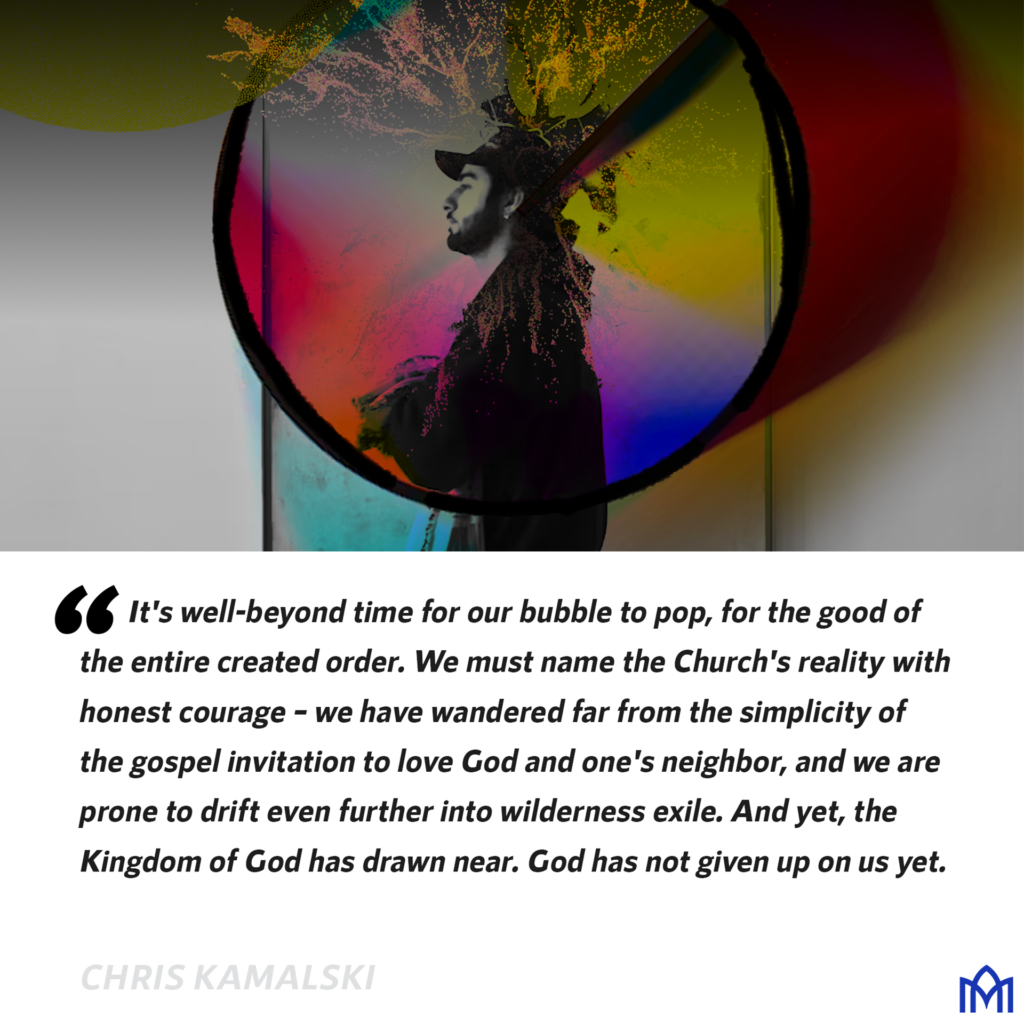
"It's well-beyond time for our bubble to pop, for the good of the entire created order. We must name the Church's reality with honest courage–we have wandered far from the simplicity of the gospel invitation to love God and one's neighbor, and we are prone to drift even further into wilderness exile. And yet, the Kingdom of God has drawn near. God has not given up on us yet."
“I imagine one of the reasons people cling to their hates so stubbornly is because they sense, once hate is gone, they will be forced to deal with pain.” ~ James Baldwin
Dear Church of ‘Foreigners and Aliens,’ created in God’s Image as the Beloved,
A year ago this past week, I realized for the first time, that I, too, am an immigrant. I feel silly even typing these words now, given the systemic injustice that our immigration ‘systems’ create as we design them to exist: A deterrent to those desiring safety and a fresh start within our hometowns, instead of a place of hospitable welcome by those who have once lived in immigrant shoes themselves. I feel silly on a personal level as well, as I know better how a Christ-follower should live (Jesus answered this dilemma of one’s neighbors by repeatedly affirming that our invitation is towards compassionate mercy and a refrain from judging the intentions of another human being).
And yet, I remain the epitome of privilege within our world, and thus live within a bubble of safety that I have a propensity to ignore:
- I am an American white male who is a Protestant Christian, historically the highest ‘role’ of power and authority within our cultural and familial systems.
- I am wealthy given global economic levels, and readily have food, shelter, and all of my basic needs for survival at hand.
- I am Western-educated at the highest levels within my academic discipline (The title “Dr.” can be used before my name!), and have essentially limitless developmental resources at my fingertips that I can access to mature and grow in my life.
In other words, I am easily able to conveniently forget where I have come from, and where I am going in this world, simply because I choose to do so. There is a freedom and power in this ability that I dismiss far too easily.
A year ago however, I was starkly reminded of the audacity of this false belief.
Standing idly in the December holiday queue at the South African immigration services, preparing to submit yet another mountain of paperwork to renew my spousal visa, a process I have successfully completed numerous times over the past 15 years of living overseas, I never conceived of the weeks of deep anxiety that lay before my family. My wife, an Afrikaans South African whose family has lived for generations in South Africa, was overseas in the Netherlands for an important year-end event with her community development organization. My kids were playing at our neighbors house, and as I waited in the endless queue for my visa renewal appointment, I was unprepared for the chaotic series of events that would unfold over the December holiday period:
I was told that first day that a new law had been passed to limit fake marriages, and that my South African spouse, who was over 8,400 miles away in Amsterdam, was supposed to be present with me to affirm that my visa renewal was genuine. Cue scramble. Could I FaceTime her or have her submit an electronic affirmation? No. Could we reschedule our appointment for the day after she returned home, even though my visa would be nearing expiration? Sort-of, but we would be forced to wait in a queue for folks seeking visas without appointments, many without proper documentation. My only option was to return the next day and begin this wait.
Within a few moments, my entire reality on immigration began to shift. I entered a chaotic, scary, multi-week process of returning to this immigration office as early as 4am each day to line-up in this queue, repeatedly waiting over 12 hours multiple days in a row, only to be told each time that there was no one who could help me (I’ll add: Even though multiple hours of the business day remained each day). I met South Africans with a spouse from another country, or whom had lost official documentation, or who simply wanted an opportunity to escape the violence, political instability, or lack of economic opportunity within their home countries.
A generous and kind Pakistani man I befriended in line next to me one day told me that he had stood in this same queue every 18 months or so since 2012, and was still fighting to receive his visa. He was a local business owner in South Africa, married to a South African, paid taxes, and was financially well-off in Pakistan. Another man in the queue was from Bangladesh, also married to a South African, and had run a fruit and produce stand for decades that supported his family of 5. I saw an Anglican woman clutching rosary prayer beads, praying in fervor for her spouse, who had disappeared into the office inside.
To a person, the folks I met in these immigration queues were kind, honest, hard-working people who simply wanted to provide a better life for their families, and for a variety of reasons largely outside of their control, found themselves as desperate as I now was.
These fellow human beings, many of whom had showed up daily for weeks in an attempt to sort out their papers honestly within the system, were filled with empathy, kindness, and an other-centeredness for one another that was striking to me.
I’ll never forget another Pakistani man, who upon learning that I was American, spoke with real compassion about my plight, knowing full well the injustice of the American immigration system, in particular towards those from the Middle East. This man wanted me to be safe and secure with my own family, as I did with his. He told me his own story, with a South African friend encouraging him to persevere: “You are not my enemy, Yusef.”
You are not my enemy.
What a profound statement of compassionate other-centeredness, the heart of what it means to love one’s neighbor. I left that day without my visa (with several weeks of anxiety remaining before I was miraculously sorted out), but with a heart renewed at humanity’s inherent goodness.
I found myself wondering, perhaps the statement itself “You are my enemy” is the enemy–the biggest straw man of all time.
I, Too, Am An Immigrant
Church, let me be frank: We lack empathy and other-centeredness. With a few exceptions, we are failing at the basic stuff that makes us Christian: loving our neighbor as ourself.
This is true on an embarrassing number of levels (How we treat those with whom we disagree politically, how we serve those within our families that see differently on an ethical/cultural issue, etc.), but it is cruelly evident in how we treat the marginalized and vulnerable within our midst. Stunningly so, this wrath is particularly vile, if not outright sinfully evil, in the cruel barbs an unjust systems directed at the immigrants in our midst. Instead of extending a hospitable, kind, incarnational welcome, adding another seat to our table of belonging, we choose to strengthen walls of division and separation. We fear those we have never bothered to even name,
Why is this so?
Many reasons exists, much of which lands outside my own understanding and limited area of expertise, but I’ll posit this: We do not welcome the stranger in our midst because we have forgotten and ignored the reality that we were once aliens ourselves. I deny the reality that my own family immigrated to America from Germany and Scotland, Poland and the Ukraine, and that every single ethnic group outside of First Nations Indigenous peoples, and the generations of African Americans cruelly enslaved under the system of chattel slavery, came to America of their own accord.
I, too, am an immigrant. We are a nation of immigrants.
As a Christ-follower, what is even more troubling is that this is central to the life of faith we live in this world, within a Kingdom that has broken in but is still in the process of being fully realized. The writer of Hebrews acknowledges this reality of our journey of formation beautifully:
“All these people were still living by faith when they died. They did not receive the things promised; they only saw them and welcomed them from a distance, admitting that they were foreigners and strangers on earth. People who say such things show that they are looking for a country of their own. If they had been thinking of the country they had left, they would have had opportunity to return. Instead, they were longing for a better country–a heavenly one. Therefore God is not ashamed to be called their God, for he has prepared a city for them.” (Hebrews 11:13-16, NIV)
We are foreigners and strangers on earth. We long for the true country we are made for. This is who we are in Christ!
Church, let me be frank: We lack empathy and other-centeredness. With a few exceptions, we are failing at the basic stuff that makes us Christian: loving our neighbor as ourself. Share on X
Our Narcissism Permits this Bubble to Exist
As the Church, we are not a people of welcome in part because of our own narcissism. We allow a sense of entitlement to create a self-fulfilling prophecy of sorts, believing that the Church exists to meet my own needs. I do not participate in the Body of Christ to elevate, empower, and seek the good of my neighbor; the Church exists to serve me the buffet that I want and need. We are cogs in a capitalist wheel, trapped in what Brian McClaren prophetically described in his 2007 book, A Generous Orthodoxy, as a “suicide machine” of our own making.
How have we strayed so far from the teachings of Jesus? How have we needlessly (intentionally?) complicated these words of Christ: “For I was a stranger (Greek: Xenos, from which ‘xenophobia,’ the fear of strangers, comes from) and you welcomed me” (Matthew 25:35).
We have created a bubble of our own making, to protect ourselves. In so doing, we are increasingly isolating ourselves as the American Church. This has happened before in history, leading to scary years of war, violence, and chaotic rhetoric.
Will we allow it to happen once more? Or will the Church stem the cultural tide and imagine a better way?
Hope is a Discipline
My wife was speaking to my best friend last week about these realities, and I cynically asked them if they felt things would ever get better again (for our world, within the Church, in our own families). Here’s what my best friend said to me, which my wife readily agreed with, leaving me speechless:
The activist Mariame Kaba famously said “Hope is a discipline.”
As I looked at them with disbelieving eyes, I listened as they both agreed that hope is the only way forward. We must not despair, and thus delay (or discontinue) doing good. They both refused to give up, even as things felt dark, scary, even hopeless. Why was this so? Perhaps the context of Kaba’s full quote provides a window of insight:
“Hope is a discipline. It’s less about ‘how you feel,’ and more about the practice of making a decision every day, that you’re still gonna put one foot in front of the other, that you’re still going to get up in the morning. It’s work to be hopeful. It’s not like a fuzzy feeling. You have to actually put in energy, time, and you have to be clear-eyed, and you have to hold fast to having a vision. It’s a hard thing to maintain. But it matters to have it, to believe that it’s possible, to change the world.” (Mariame Kaba)
We have created a bubble of our own making, to protect ourselves. In so doing, we are increasingly isolating ourselves as the American Church. Will we allow it to happen once more? Or will the Church imagine a better way? Share on X
Our Bubble Must Pop, For Good
There is a haunting scene in Wicked: For Good that I cannot stop thinking about. Elphaba, the “Wicked Witch of the West,” has been vilified by the leaders within the land of Oz, made the enemy in order to maintain order and control within Oz itself. Her best friend Glinda “the Good” is deeply troubled by this, but is trapped within her own privilege, wrestling with what she is to do. Elphaba’s words to Glinda unlock something in her spirit, and lead to the central resolution of the film, and of the story of Wicked itself.
Here’s Elphaba’s haunting words to Glinda:
“They need someone to be wicked so you can be good. Look at me; not with your eyes, but with theirs. We can’t let good be just a word. It has to mean something. It has to change things.”
Glinda lived within walls of privilege and protection. Her goodness was largely manufactured. She literally traveled in a bubble. Elphaba, by contrast, was inherently good. She fought for the marginalized, risked her own relationships, and sought to reimagine a better Oz for all. At the cost of her own safety, she invited Glinda to step outside her bubble, for the good of everyone she led as Queen of Oz. Glinda realized her bubble must pop.
The same invitation exists for us, Church.
It’s well-beyond time for our bubble to pop, for the good of the entire created order. We must name the Church’s reality with honest courage–we have wandered far from the simplicity of the gospel invitation to love God and one’s neighbor, and we are prone to drift even further into wilderness exile. And yet, the Kingdom of God has drawn near. God has not given up on us yet.
Our bubble must pop, for good.
Our bubble of narcissism, self-interest, and self-protection must be punctured.
Our bubble of straw man enemies and empty theological rhetoric must be pierced.
Our bubble of fear must be popped.
We all are created good, inherently bearing the Image of God.
What if we disciplined ourselves in hope to imagine a better way?
This is the invitation of the Church. Our Church. Everyone’s Church.
Will you join me?
~ Chris
///
Hope is a discipline. It’s less about 'how you feel,’ and more about the practice of making a decision every day, that you’re still going to get up in the morning. It’s work to be hopeful. (Mariame Kaba). Share on X
*Editorial Note: Letters to the Church is Missio Alliance’s newest long-form series. The latest letter to our growing collection will go live each Friday throughout the rest of 2025. We invite you to prayerfully listen to the Spirit as you read, asking God what you might say to the Church in your own voice. ~CK
“Anyone with ears to hear must listen to the Spirit and understand what God is saying to the churches.” (Revelation 2:29)