We Abandoned Our Mothering God: Recovering Collective Trust
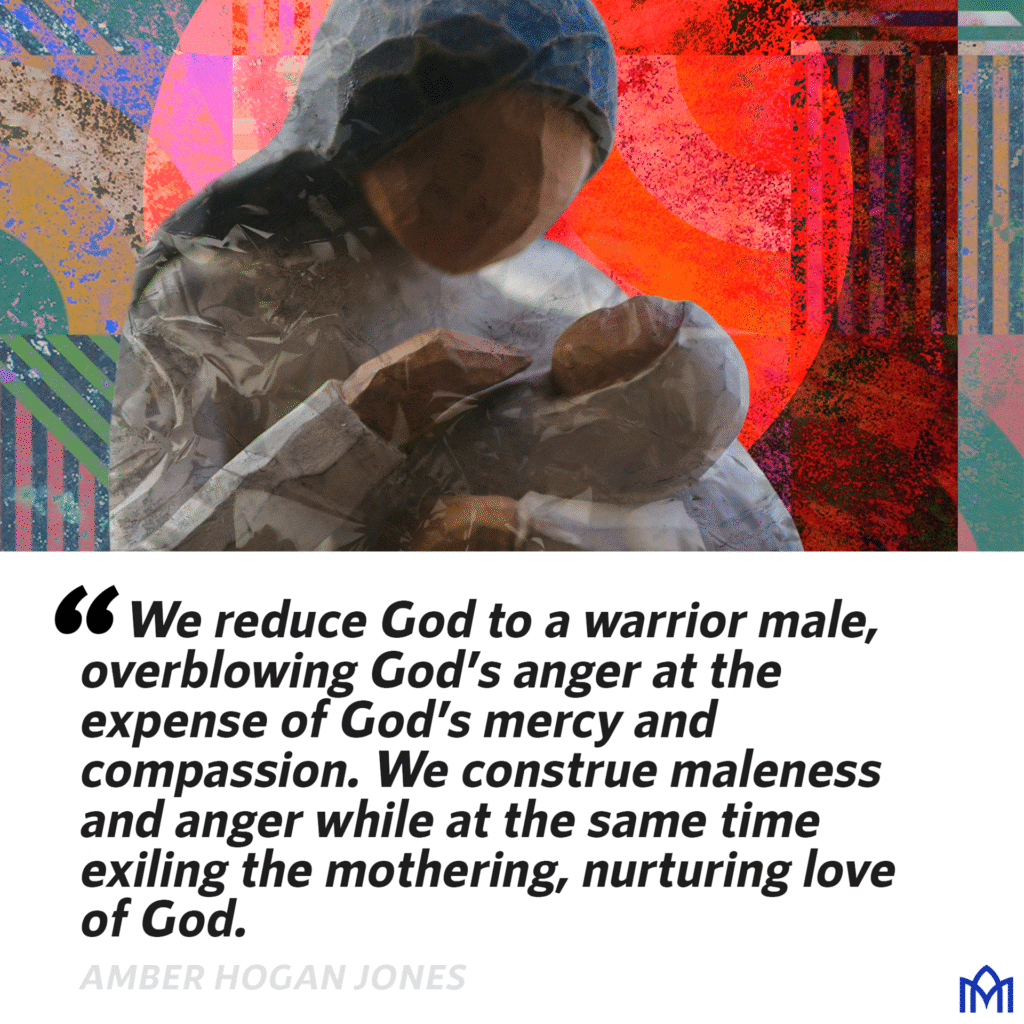
"We reduce God to a warrior male, overblowing God’s anger at the expense of God’s mercy and compassion. We construe maleness and anger while at the same time exiling the mothering, nurturing love of God."
Recovering Collective Trust (Series, Pt. 1)
“Does a woman forget her babe, have no mercy on the child of her womb? Though she forget, I will not forget you. Why, on My palms have I inscribed you, your walls are before me always.” (Isaiah 49: 15-16, The Hebrew Bible: A Translation with Commentary, by Robert Alter)
“It starts to feel like the world’s not worth living in anymore.” I absorbed the shock of this young person’s words while sitting across from them in a crowded café. The redolence of coffee and cinnamon rolls, mixed with the happy noise of chatting patrons, offered a strange context for the turn in conversation. In retrospect, the scene almost perfectly images the perplexing times in which we live.
We’d arrived at this dark point in our afternoon coffee date because of the days’ news, in which corruption and lying were, yet again, dominating the headlines. Added to the newest revelations of moral decline in the public sphere, this young person was grappling with the bewildering experience of trying to have honest conversations with people of faith who seemed to be unconcerned with the truth, so passionate was their need to defend their partisan political positions.
My heart sank as I sat across from this young person and, identifying with the maternal love of Jesus when He surveyed Jerusalem so long ago, I yearned to gather them “as a hen gathers her brood under her wings,” (Matthew 23:37, NRSV) protecting them from all that is wrong in the world.
If we’re being honest, we may identify with this young person’s perspective too. After all, we’re exhausted, scared, and unsure how to solve our problems.
I can confidently make these claims because the data bears out this truth. In fact, 1 in 10 US adults experienced a mental health crisis last year, to say nothing of our nation’s children.1Lindsey Culi, Johns Hopkins University. Accessed at https://publichealth.jhu.edu/2025/mental-health-crisis-hits-nearly-1-in-10-us-adults. Social scientists, pastors, and political pundits have proposed a number of reasons for the prevalence of our collective angst, but the foundation of our issues seems to be widely agreed upon: a rise in grievance coalescing with an erosion of trust.
Crisis of Trust
According to data collected by Pew Research, each recent birth cohort in America is less trusting than the previous one. This means that, for every generation that expires, there is a gaping hole that trust once filled; and rather than working on that trust problem, we’re recklessly allowing the hole to grow into a canyon. The reasons for this are myriad: political polarization, internet and technology, news and media (In particular, not being able to detect lies), tension born of diversity, decline/stagnation of religion, and how and where we spend our time (Increasingly alone instead of in community), according to researchers.2Source: https://www.pewresearch.org/2025/05/08/americans-trust-in-one-another/.
The 2025 Edelman Trust Barometer, a global report on trust and the crisis of grievance developed by the Edelman Trust Institute, provides further detail of what’s happening on a global scale when it comes to the erosion of trust. Referring to what’s beneath our distrustful hearts, the folks at Edelman call this a “Crisis of Grievance,” in which we lack optimism for the next generation because of a pervading sentiment that “your gain is my loss.” In fact, researchers found that grievance has taken hold of the majority across all countries measured, with 1 in 2 young adults reporting that hostile activism is necessary to drive change in the world.32025 Edelman Trust Barometer, a global report on trust and the crisis of grievance, developed by the Edelman Trust Institute. Accessed at https://www.edelman.com/sites/g/files/aatuss191/files/2025-01/2025%20Edelman%20Trust%20Barometer%20Global%20Report_01.23.25.pdf
Let that truth sink in: Roughly half of young people worldwide believe that they must engage in or endorse hostile acts for the sake of their own survival.
Scarcity Mindset: I Won’t Be Given Care
The neuroscience of how trust demonstrates that being heard, seen, and valued are the necessary components for developing and maintaining trust.4Paul Zak, The Neuroscience of High Trust Organizations. Accessed via https://neuroeconomicstudies.org/wp-content/uploads/2017/07/The_Neuroscience_of_High_Trust_Organizations_CPJ_2018.pdf. Without these, human beings cannot develop trust in others and, it stands to reason, they cannot develop trust in God either. When we don’t feel seen, valued, or heard, we naturally seek safety in other ways–namely, we gravitate toward our own self-interest because we don’t believe anyone else will provide for us. This way of being plays no small part in creating a world that decidedly doesn’t feel worth living in.
Another word for being seen, heard, and valued is intimacy. Thinking back to Jesus’ words as he looked out over Jerusalem, one can hear the cry of our Lord for intimacy with the people below who were fumbling about, working on their own self-protective ego projects instead of coming to the Source of all that their hearts really needed. Jesus was offering them, and us, the opportunity to lay aside grievance and re-establish trust instead.
Unfortunately, they couldn’t receive His invitation to intimacy because they were looking for a Conquering King who would violently overturn all that they perceived as unjust in their world, a Warrior that would address their collective grievance. We’ve fallen into the same trap today, with pastors and theologians and podcasters recasting God in the image of a vengeful warrior and destroyer of “evil” people. Moreover, there’s a dark sentiment rising in ‘Christian America’ in which “feminization” of the faith is blamed for the so-called gender gap in church attendance, and in the “softness” of Christian teaching in general.5Katie Herchenroeder, “Pete Hegseth Reposts Video of His Pastor Criticizing A Woman’s Right To Vote.” Vanity Fair, August 10th, 2025. Accessed via https://www.vanityfair.com/news/story/pete-hegseth-reposts-controversial-pastor-comments-about-women-and-voting. In other words, the feminine is at once a weakness6Rod Dreher, “The Feminization (and Decline) of Religion.” The American Conservative, April 2nd, 2018. Accessed via https://www.theamericanconservative.com/the-feminization-and-decline-of-religion/. and a threat.7Mark Wingfield, “Basham and others link criticism of Budde to threat of female preachers.” Baptist News Global, January 23rd, 2025. Accessed via https://baptistnews.com/article/basham-and-others-link-criticism-of-budde-to-threat-of-female-preachers/.
We reduce God to a warrior male, overblowing God’s anger at the expense of God’s mercy and compassion. In doing this, we construe maleness and anger while at the same time exiling the mothering, nurturing love of God. Both men and women are trodden underfoot by this misguided enterprise.
In God’s mothering love, which is writ large in Holy Scripture, women and men have been given the shocking opportunity to be reborn into wholeness. Indeed, as Walter Bruggemann reminds us in his classic work, The Prophetic Imagination, “The task of prophetic ministry is to nurture, nourish, and evoke a consciousness and perception alternative to the consciousness and perception of the dominant culture around us.”8Walter Brueggemann, The Prophetic Imagination, 2nd ed. (Augsburg Fortress: 2001), 3. Through being nurtured and nourished by God’s mothering love–which includes being seen, heard, and valued–we find ourselves able to relax, perhaps for the first time, opening the pathway for trust and a new consciousness to develop.
Social scientists, pastors, and political pundits have proposed a number of reasons for the prevalence of our collective angst, but the foundation seems widely agreed upon: a rise in grievance coalescing with an erosion of trust. Share on X
Learning to Trust God
“Nothing less than a great daring in the face of overwhelming odds can achieve the inner security in which fear cannot possibly survive. It is true that a man cannot be serene unless he possesses something about which to be serene. Here we reach the high-water mark of prophetic religion, and it is of the essence of the religion of Jesus of Nazareth. Of course God cares for the grass of the field, which lives a day and is no more, or the sparrow that falls unnoticed by the wayside. He also holds the stars in their appointed places, leaves his mark in every living thing. And he cares for me! To be assured of this becomes the answer to the threat of violence—yea, to violence itself. To the degree to which a man knows this, he is unconquerable from within and without.” (Howard Thurman, Jesus and the Disinherited)
It Wasn’t Always Like This: The Theft of Language
A deep, rich understanding of God’s mothering love is a traditional, orthodox Christian inheritance. In fact, a quasi-male God would have been rejected by our early Church contributors. Jerome and Gregory of Nyssa, for example, were clear that sex categories cannot possibly apply to God.9Jerome, In Esaiam (CCSL 73: 459, 1.82-83; Gregory of Nyssa, ‘Homily VII’ In Cantica Canticorum (PG 44: 916B). They came to these conclusions because of their faithfulness to what we’d term “biblical language,” seeing clearly that God is neither male or female and that both women and men image God in mysterious ways. Theologian Tim Bulkeley notes that “In the Early Church, both Clement and Irenaeus found mother a useful picture of aspects of God, and breast feeding a good image of nurture for new believers.”10Tim Bulkeley, Not Only a Father: Talk of God as Mother in the Bible and Christian Tradition, 115.
Clement of Alexandria, drawing from the multitude of verses depicting God as breast-feeding God’s people, says this of God’s powerful, life-sustaining mothering love:
“This is our nourishment, the milk flowing from the Father by which alone we little ones are fed…therefore we fly trustfully to the ‘care-banishing breast’ of God the Father; the breast that is the Word, who is the only one who can truly bestow on us the milk of love. Only those who nurse at the breast are blessed…little ones who seek the Word, the craved for milk is given from the Father’s breasts the love for man.”11Clement of Alexandria, Christ the Educator, translation by Simon Wood; Fathers of the Church, 1954)
Breasts, milk, wombs, birthing. These words, when attached to the God of our understanding, generally make us uncomfortable or offended, even though they are biblical images, and align with Christian orthodoxy. Once upon a time, it was not controversial to use these words, and other feminine language, to inform our understanding of God.
And this is the crux of the issue: when we abandoned the mothering love of God, exiling such language from our liturgies, worship, and teachings, we lost an understanding of God’s nature that is useful in developing intimacy with the God who forms the basis of our lives. Scripture records God’s sentiments for just such a position: “You were unmindful of the Rock that bore you; you forgot the God who gave you birth” (Deuteronomy 32:18). Indeed, we’ve forgotten the mothering love of God, and thus we’ve forgotten the Divine breasts that are meant to nourish us and the womb that is intended to nurture us. Why would we, like the people of Jerusalem so long ago, run from such an offering of love?
Vulnerability of Re-Wombing
We run from the intimate imagery of God’s mothering love because it makes us feel vulnerable on a deeply primal level. This is the reason Nicodemus had such a block in understanding Jesus’ explanation of what was necessary to inherit the Kingdom of God, because the imagery of becoming like a fetus suspended in the womb of our Creator is a bridge too far for people accustomed to seizing power, wealth, and influence as methods for self-protection, though Jesus found his mental block perplexing in light of the self-evident truth Jesus was providing (See John 3:1-10). Indeed, as theologian Elizabeth Gandolfo notes: “Vulnerability not only exposes human beings to harm, it is also the condition for the possibility of healing, health, and wholeness.”12Elizabeth Gandolfo, The Power and Vulnerability of Love: A Theological Anthropology, 1.
Resistance to vulnerability is simultaneously the most reasonable and unreasonable position for the human heart. “Human vulnerability acquires the meaning of the ability of each man and woman to be affected, bodily, mentally, emotionally, and existentially by the presence, being, or acting of someone or something, or other. In a general sense, it means openness, permeability, relationality, transformation, and communication,” asserts theological researcher, T.E. Reynolds.13T.E. Reynolds, Reframing Vulnerability through and Embodied Theological Lens: Towards Ethical Engagement in a Globalized Context. This is a big ask of us, to be sure. However, comfort can be found in the fact that we were never meant to take this journey of vulnerability alone.
A deep, rich understanding of God’s mothering love is a traditional, orthodox Christian inheritance. In fact, a quasi-male God would have been rejected by our early Church contributors, for God is neither male or female. Share on X
Learning to Trust One Another
“For the Christian seeks neither autonomy nor independence, but rather to be faithful to the way that manifests the conviction that we belong to another.” (Stanley Hauerwas, A Community of Character: Toward a Constructive Christian Social Ethic)
Being Re-Wombed Together
The idea of being re-wombed is daunting enough, evoking the spectrum of dread and attraction that German theologian Rudolf Otto noted is common when approaching the mysterium tremendum, or the wholly other, that is God. Add to that the notion that we must embark on this journey together, with more others, none of which are inherently healthy or trustworthy either, and we arrive at the cliff’s edge where most Christians either sit down or walk away from the entire idea, dismissing Jesus’ words and the theology of the Church Fathers as too lofty or impractical for the world we live in today. Yet can’t we hear the echo of our mothering God’s voice as recorded in Isaiah 49:15-16: “I will not forget you. Why, on My palms have I inscribed you.”
What we’ve been doing–this ever-increasing againstness, this comfortability with in-groups and division, this breaking off into ‘us vs. them’ camps–is not working. The Church is meant to provide the antidote to all of that but, instead, the Church has for too long fueled these fires in the name of a Warrior God who desires judgment over mercy.
It’s time for new wine that simply will not fit into these raggedy wineskins to which we’ve been fearfully clinging. God is longing for us to return to intimacy, not only in our private prayer rooms, but also, and perhaps especially, in our collective gatherings. We are meant to enter the womb of God together, be undone and re-formed together, receive nourishment and nurturance in our innermost parts together, be birthed back into the world together, and to nurse at the breast of God’s Presence and Word together.
It is only through this shared experience that we can learn to trust.
It is only through witnessing the miracle of one another’s re-wombing experiences that we can learn to truly share a common humanity that transcends grievance. As theologian Howard Thurman reminds us, this is the only antidote to violence–to know, in the most intimate parts, that we are loved and that we are capable of loving in return.
Perhaps the mothering love of God is the missing piece to the puzzle of how we move forward together in a time of cataclysmic upheaval. Perhaps the miracle of being born again isn’t about saying a prayer, reading our Bibles, and going to church, but is about experiencing a re-wombing so intense that we radiate an openness, permeability, relationality, and communication pattern that leaves the world around us stunned. We’ve thoroughly explored the image of God the Warrior and Conqueror. Maybe it’s time to reclaim the joy and relief that comes from an image of God the Nurturer and Nourisher.
The young person sitting across from me at the coffee shop longed for a world worth living in and their cry recalls Jesus’ teaching on how we are meant to pray: “God’s Kingdom come, God’s will be done, on earth as it is in heaven.” The invitation is to throw open the doors of our imaginations and welcome the fulness of what God is offering the world—which is nothing less than an offering of Divine wings of mothering love which long to pull us near to the heart of God, to envelope us in safety, and create a context for us in which all fear and grievance come untrue.
///
*Editorial Note: I have immense respect for Rev. Dr. Amber Hogan Jones. Her deep writing, impeccable theological research, and warm formational invitation into the nurturing, mothering heart of God is compelling. I urge you to listen to her. ~CK
We run from the intimate imagery of God’s mothering love because it makes us feel vulnerable on a deeply primal level. Share on X