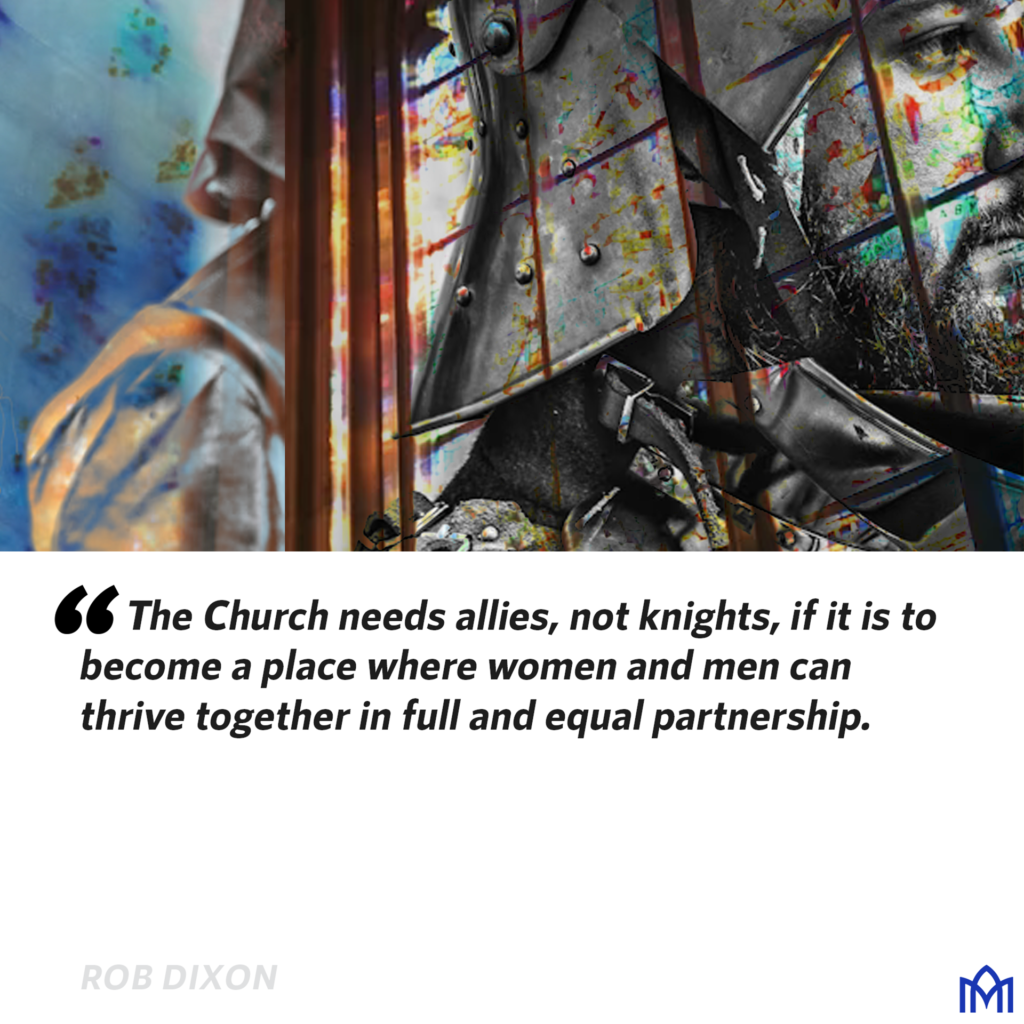
We Need Allies, Not Knights
"The Church needs allies, not knights, if it is to become a place where women and men can thrive together in full and equal partnership."
What could it look like for the church to develop more men into more effective allies to women? This question has animated my reading and writing over the last several years, and as I’ve done my research, it’s become clear that there is a distinction to be made between a male ally and a knight in shining armor. Gabriella’s story will help illustrate this distinction.
Gabriella was a rockstar with a long track record of ministry success. Still, as a woman working in a male-dominated ministry environment, Gabriella was always on the lookout for male colleagues who lend a hand should she need help navigating her vocational situation.
In this case, Gabriella was dealing with a male supervisor who was clearly uncomfortable having a woman as his direct report. At first, Gabriella considered confronting her supervisor herself, but, ultimately, she decided that doing so would expose her to more pain and discomfort. She could just tell that her pleas for equal treatment would be minimized, or, worse, ignored altogether.
That left the ally approach. Gabriella decided she would benefit from both solidarity and advocacy from her male colleagues, and there were two men in her office for Gabriella to choose from. Both had expressed an openness to functioning as an ally for her in the past.
Bill was an up-and-coming leader, eager to make his mark. Gabriella knew that Bill would be full of zeal, but she worried that he might view an allyship opportunity as another feather in his personal ministry cap.
Gabriella’s other ally option was Javier. Javier was a stalwart in the office, and he had a track record of quiet but effective allyship. He would certainly not be as flashy as Bill in his allyship, but Gabriella sensed that Javier would do the work for all the right reasons, and that he would be in it with her for the long haul.
///
In her book Better Allies, Karen Catlin explores the distinction between an ally and a knight in shining armor. In the story above, Bill would seem to fit the profile of a knight, while Javier would fit better as what I call a habitual ally.1This story, and this article more broadly, engages the topic of allyship in the context of gender, which is my personal area of concern. But any area of social different could be examined, and the principles here would be relevant. In the following table, I will draw a contrast between male knights and male allies.
|
KNIGHT |
HABITUAL ALLY |
|
| Definition | “in business, we don’t need knights in shining armor, but we do need allies to take action and be ambassadors for change. How will you make sure you’re acting as an ally, not a knight? What systemic changes can you institute to create more inclusive workplace cultures—not just for a marginalized individual or two, but for all?” | “a man who is engaged in an active process of understanding his privilege and empathetically seeking to leverage that privilege to benefit women both interpersonally and systemically” |
| Time period | Knights generally look for short-term allyship wins | Habitual allies tend to be invested for the long haul, pursuing systemic change |
| Motivation | Knights can operate from a place of genuine service, but, more often, they are motivated (though they might not realize it) to gain respect and acclamation from others | Habitual allies are motivated to improve the status of individuals, communities, and systems. They approach the allyship task as a servant. In their book Good Guys, David G. Smith and W. Brad Johnson write, “allies aren’t saving women. They don’t see an opportunity to take control of gender initiatives and rescue women from inequality…instead, allies emphasize humility and gender partnership…to create and support inclusive workplaces.” |
| Posture toward marginalized group | If they aren’t careful, knights might think they already know what the marginalized group needs | Habitual allies are eager to listen and learn, and then tend to wait for permission to act on behalf of a marginalized group |
| Who benefits? | A marginalized group might benefit in the short term, but the knight’s reputation and stature tend to be the primary beneficiaries | A marginalized person or group benefits from an ally’s continued efforts |
This contrast between knights and habitual allies surfaces at least three implications worth considering by individuals and communities.
- First, this analysis makes the case that the Church needs allies, not knights, if it is to become a place where women and men can thrive together in full and equal partnership.
I like to think of male allyship as one means to the greater end of the gender equity described so eloquently in the creation account, where we learn that women and men share both the image of God as well as the command to steward God’s creation. Male allyship, then, is a means to that larger end.
While allies are preferable to knights, it is also possible that being a knight can be a step in the right direction. After all, sometimes knights are indeed effective in bringing some level of change. And yet that change is likely to be short-lived if knights don’t pivot to become habitual allies. More on that pivot below.
- Second, for men who aspire to be allies, it’s worth considering if they are instead operating like a knight.
Catlin provides a list of questions that can be useful in determining whether or not someone is operating like a knight:2Catlin, 35-36.
-
- What do I hope to accomplish by doing this? This question gets to motivation, and its answer should be something deeper than “I want to look good in the eyes of others.”
- How many people will this help? Catlin’s primary differentiator is that allies have a systemic focus. Knights swoop in to save an individual or two; allies take a broader view.
- How will my actions/response change ingrained behaviors within my company? Changing “ingrained behaviors” is hard work, and knights are rarely interested in that level of effort.
- If I do/say this, will it matter to anyone a year from now? Five years from now? Allies want to make a lasting impact.
- Will this action create equality or equity? Will it remove barriers? This question reminds us of the bigger picture, discussed above. God’s creation intent is for full gender equity.
- Third, the good news is it is possible for a knight to become a habitual ally.
Consider the following action steps:
-
- Understand your motivation. Allies are in the game for the right reasons. In my experience, would-be allies tend to need help from others in rightly assessing their motives. Who can help a would-be male ally do this work?
- Allies choose to listen and learn before they act. If men are motivated to support or assist women in their ministry contexts, they must make sure to place themselves in a learner’s posture, not assuming they know what’s best. A general allyship guideline would be to only act with the blessing of the marginalized group you aspire to support.
- Be brave and act. Catlin outlines seven different allyship roles: scholar, confidant, amplifier, sponsor, champion, upstander, and advocate.3Catlin, 19-27. In my book, I spend a chapter exploring each of these roles, offering examples from the life of Jesus and providing practical ways to live out each role. See Dixon, 79-96. Would-be allies should carefully consider which role to use in a given situation. After making that assessment, they should be brave and act!
- Repeat the above three steps. Effective allies are diligent about constantly checking their motives, seeking evaluative input from the marginalized community they are attempting to serve, and becoming more effective in their allyship.
///
After making the determination that approaching her manager on her own would be unsafe or unpalatable for her, Gabriella had a choice to make in selecting a male colleague to support her leadership. Bill was a knight, and while he might make a splash in the short run, Bill’s allyship was unlikely to provoke lasting change. Maybe he could become a habitual ally in time, but he wasn’t ready yet. By contrast, Javier was a bona fide habitual ally, and gaining his support opened the door to a safer and healthier ministry environment for Gabriella.
Male allyship is one means to the greater end of the gender equity described so eloquently in the creation account, where we learn that women and men share both the image of God as well as the command to steward God’s creation. Share on X///
*Editorial Note: Rob Dixon is a long-time friend of Missio Alliance. His brand-new book, Allies in Ministry: How Men Can Support Women in God’s Mission, is the latest book in the Missio Alliance & IVP Book Series. It releases wide on April 21st, 2026. Join Rob & co-host Sarah Schepens for Book Club in May & June 2026 as a means to dialogue through Rob’s book together. Register here. ~CK